International tour logistics need one accountable record for route, equipment, customs method and return. Use this checklist before cases leave the warehouse.
International tour logistics is the operating discipline that moves people, equipment and show-critical materials across borders while preserving the evidence required to bring temporary goods back. For a promoter or tour manager, the practical job is not simply getting cases onto a truck. It is making the route, the inventory, the customs method and the responsible people agree at every handoff.
That distinction matters because one incorrect serial number, one unplanned transit country or one unowned customs presentation can put a show-critical item behind the schedule. A strong plan does not promise frictionless clearance; it makes the right questions visible early enough to resolve them.
This is an operating framework, not customs, tax, immigration or legal advice. Requirements differ by country, goods, route and purpose. Use qualified local customs, freight and legal advisers for the actual movement.
What is an ATA Carnet for touring equipment?
An ATA Carnet is a customs document used for temporary admission in participating territories. It can support the temporary movement of eligible professional equipment, commercial samples or exhibition goods; it is not a universal pass for every country, every item or every licence requirement.
The UK government’s June 2026 ATA Carnet handbook says the holder must show the carnet and goods at each relevant import or export movement, and that goods must remain unaltered and be returned to the issuing country. Its application guidance also requires a route that includes destination and transit countries. Those are UK-issued-carnet instructions, not a replacement for destination-country advice.
The document follows the goods only when the people, route and item record are prepared to follow it too.
Start with a movement brief, not a packing list
Before a carrier is appointed, write one movement brief that answers: what is moving, who owns it, where it starts, every border it will cross, why it is entering, how long it will stay, and how it returns. Include production, lighting, audio, video, wardrobe, merchandise, replacement parts and consumables in separate categories. Treating all cases as one temporary-admission population is a common planning error.
The brief should identify whether each item is:
- Temporary professional equipment that may be eligible for a carnet or another temporary-admission route.
- Consumable or sellable stock that needs a different import, tax or sales treatment.
- Controlled, wireless, high-value or regulated equipment requiring a territory-specific check.
- Local rental or replacement equipment that should not be added to an export record simply because it appears in the production plan.
WENOTIFT’s artist booking contract checklist explains why touring responsibilities should be specified before show week. The logistics plan turns those commercial responsibilities into a physical movement record.
The six-part international tour movement chain
Together these controls form the Movement-to-Return Chain, a WENOTIFT operating framework rather than a customs standard. Its purpose is to expose the handoff that has no owner before the border exposes it.
Build an inventory that a border team can actually use
Production inventories are often detailed enough for load-in but too informal for movement control. Create a master register with one stable identifier per case or item, then use that identifier in the packing list, freight instruction, insurance schedule and customs documentation.
| Record | Minimum useful detail | Primary owner | Failure prevented |
|---|---|---|---|
| Route sheet | Dates, countries, transit points, ports, venues and return path | Tour manager | Unplanned border or insufficient vouchers |
| Goods register | Case ID, item, serial number, value, owner and purpose | Production manager | Mismatched or vague item descriptions |
| Entry-method log | Carnet, permit, broker instruction or local-import treatment by item/territory | Customs lead | Assuming one method covers all goods |
| Border handoff sheet | Presenter, contact, document custody and completion proof | Freight lead | A movement with no accountable representative |
| Exception log | Split, substituted, damaged, delayed or locally sourced item | Tour and freight leads | A physical change invisible to the record |
| Return reconciliation | Re-import evidence, missing-case status and closure date | Tour manager | Unresolved temporary-admission exposure |
Avoid descriptions such as “tour gear” or “miscellaneous equipment.” The aim is not decorative detail; it is enough specificity for the right case to be recognised and reconciled. Photographing seals and case labels may help operations, but it does not replace the documentation a customs authority requests.
Plan every border presentation
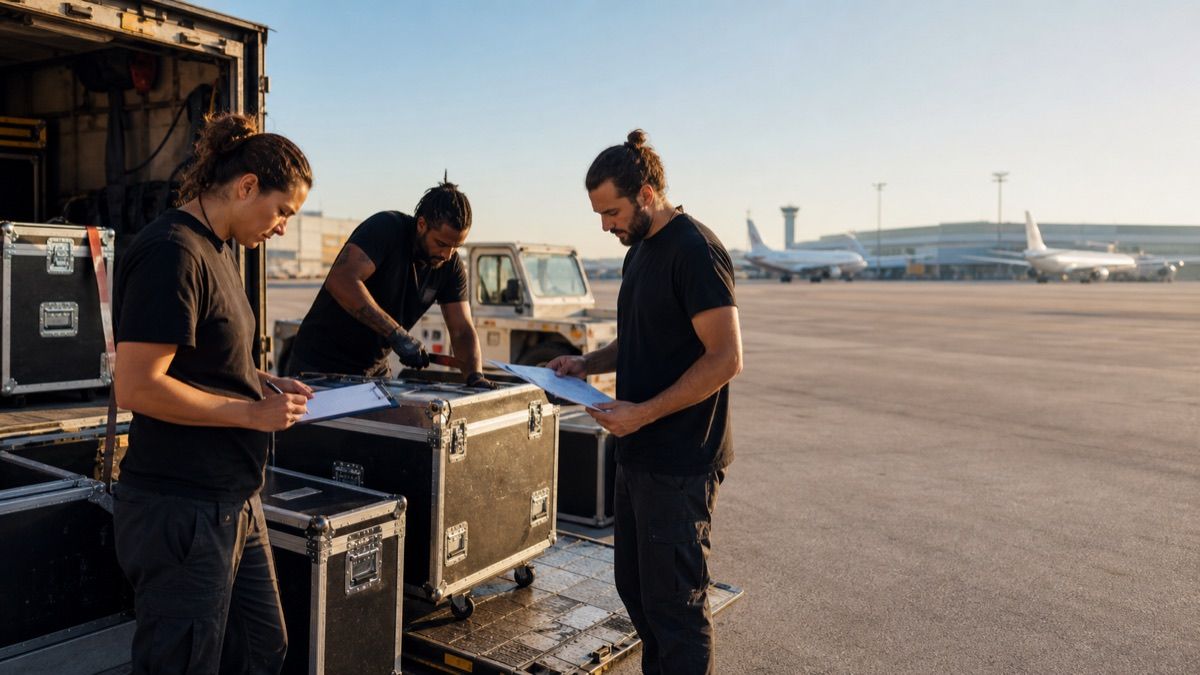
An international route contains more borders than the event calendar suggests. Airfreight, road movements, a temporary warehouse, a replacement item or a return shipment can each create a distinct presentation moment. Assign one named person to confirm completion and one fallback contact if the primary representative is unavailable.
HMRC’s current technical guidance on using an ATA Carnet says a holder must present the carnet and goods each time they import, export or transit. The ICC’s eATA transition guidance shows that digital and paper processes can coexist during the transition. Do not assume a phone screen, a paper booklet or a remote copy is accepted on a given route without confirming the applicable procedure.
Create a simple border call sheet: arrival time, carrier, broker, presenter, document location, local contact, goods count, expected proof and escalation number. This is especially useful when the artist team, production vendor and freight forwarder are different organisations.
Treat split shipments and substitutions as decisions
Split shipments are operationally normal and documentarily sensitive. A delayed backline case, a locally rented console or a substituted camera can change which items are physically present at a crossing. The ICC notes in its special travel scenarios guidance that not all customs accept split consignments and that each portion needs its own declaration in the digital process where used.
Do not solve a split by quietly changing a spreadsheet after departure. Pause and determine which record, representative and authority needs to see the change. The right answer depends on the route and customs treatment; the operating requirement is an auditable decision.
Use the same discipline for damaged equipment. A repair, disposal, sale or replacement can change temporary-admission obligations. Keep commercial pressure from turning a local workaround into an unrecorded border event.
Connect logistics to the show decision
Logistics affects the creative and commercial plan. A late equipment movement may change a production design, guest experience, sponsorship deliverable or cancellation decision. WENOTIFT’s event-demand forecasting guide helps teams model the commitment before contracting; the logistics layer should be added to the same go/no-go discussion.
For contingency planning, define what can move late, rent locally, travel with the crew, be duplicated or be removed from the show. Do not describe an alternative as viable until the rights, safety, production, venue and customs implications are owned.
Close the loop after the final show
Return is a workstream, not the absence of one. Reconcile the goods register against physical cases before loading homebound transport. Capture the relevant proof of re-export and re-import, record exceptions, and return or close the carnet through the issuing process when required.
The ICC return guidance explains that closure requires completed movement records and notification to the issuing association; hybrid processes can require the paper carnet to be returned. Keep records long enough for the applicable issuer, customs authority, insurer and contract position.
Sources
- HMRC — ATA Carnet technical handbook
- HMRC — Applying for an ATA Carnet
- HMRC — Using the ATA Carnet
- ICC ATA Carnet System — Global transition plan
- ICC ATA Carnet System — Special travel scenarios
Move the equipment with the same discipline as the show.
Talk to WENOTIFT about route intelligence, touring handoffs, venue readiness and risk gates for cross-border live-event programmes.